
A marketing budget works best when it reflects what the business is trying to achieve. Social media, advertising, SEO, content, events, and other activities can all require different levels of investment depending on their role in the overall strategy.
Understanding marketing ROI helps businesses evaluate these decisions more effectively. The goal is not to reduce spending at every opportunity, but to understand what each activity contributes, what results are expected, and where resources can create the most value.
Business Goals Give the Budget Direction
Marketing investment becomes easier to evaluate when every activity has a defined purpose. A campaign focused on generating inquiries should be measured differently from one designed to introduce a new service or increase awareness in a new market.
These objectives shape the marketing results that matter most. Lead generation may focus on inquiries and conversions, while brand awareness may consider reach, website activity, search visibility, and audience growth. Connecting spending with specific goals gives businesses a more useful basis for evaluation.
Channel Investment Should Reflect Business Priorities
Different marketing channels play different roles. Some businesses may benefit more from search visibility, while others may need stronger social media, paid advertising, content development, or brand activation.
A well-planned marketing budget considers where customers are most likely to engage with the business and which channels support current priorities. This allows resources to be distributed according to strategy rather than giving every channel the same level of attention.
Value Matters More Than Cost Alone
Marketing efficiency is not measured only by how little a campaign costs. A lower-cost activity may have limited value if it reaches the wrong audience, while a larger investment may be worthwhile when it produces relevant opportunities or supports an important business objective.
A meaningful marketing investment considers the overall resources involved, including budget, time, people, creative work, and execution. Evaluating what those resources contribute provides a more complete view of performance.
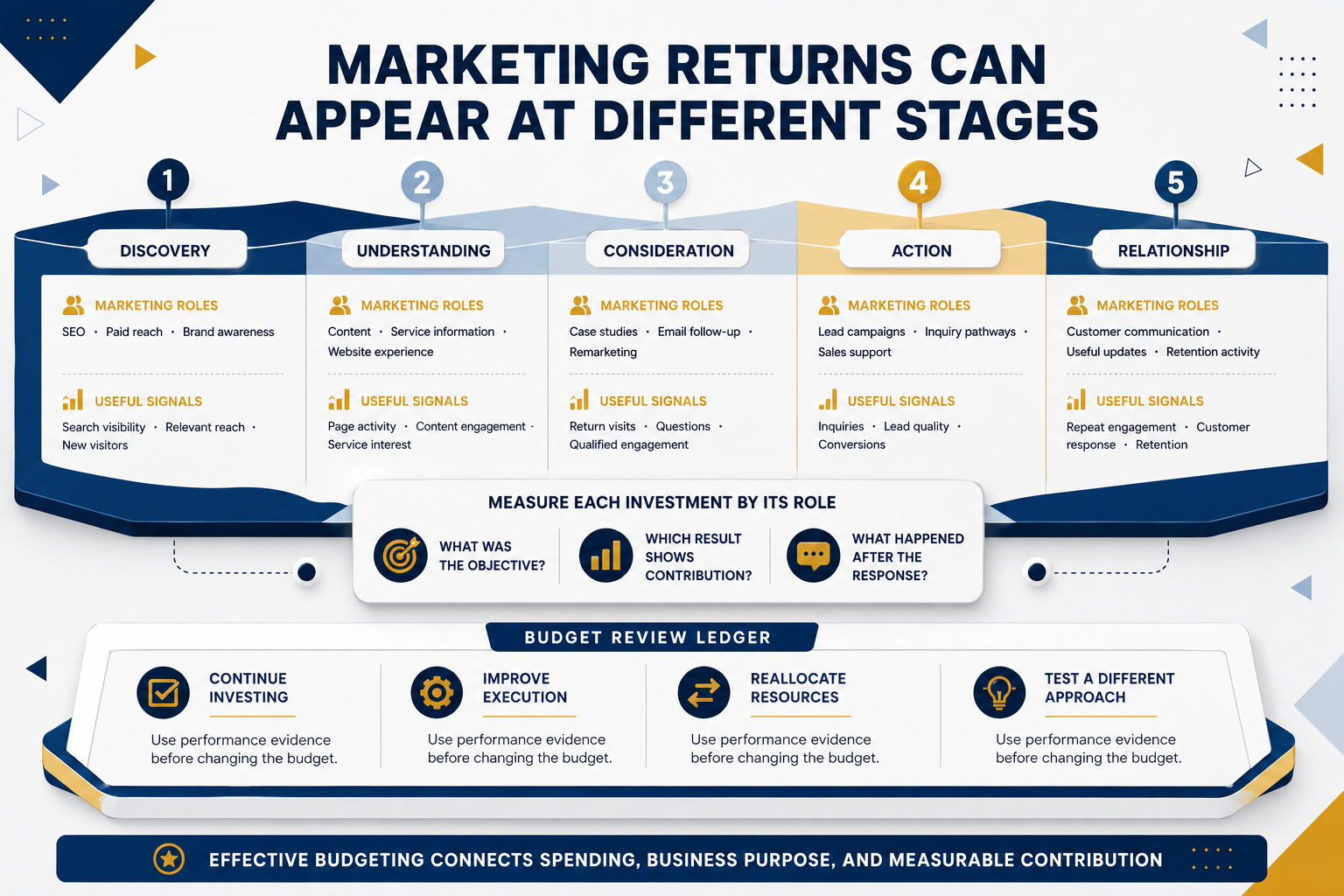
Marketing Returns Can Appear at Different Stages
Not every marketing activity produces an immediate sale. Some channels create direct responses, while others help customers discover, understand, and remember the business before they are ready to make contact.
This is why return on marketing investment should be evaluated according to the role of each activity. Search visibility, website traffic, brand awareness, lead quality, customer retention, inquiries, and conversions can all contribute to growth at different stages of the customer journey.
Performance Insights Can Guide Future Spending
Marketing budgets can become more effective when they are reviewed alongside actual performance. Campaign data, customer response, lead quality, website activity, and conversions can help show where resources are creating value.
When an activity produces useful marketing results, additional investment may help expand its impact. When performance is limited, businesses can review targeting, messaging, creative execution, channel selection, or other factors before deciding how resources should be adjusted.
ANT Connects Marketing Investment With Business Performance
At Archipelago Network Technology Inc. (ANT), marketing investment is considered in relation to business objectives and measurable performance. Campaign planning, digital marketing, content, and other activities should have a clear role within the wider strategy.
Archipelago Network Technology Inc. (ANT) can connect performance tracking and business intelligence with campaign activity to provide a clearer view of marketing ROI. These insights help businesses understand where their marketing investment is contributing and where future resources may create greater value.
Intentional Investment Supports Better Marketing Decisions
The size of a marketing budget does not determine its effectiveness on its own. What matters is how well resources are connected to business priorities, customer behavior, and measurable outcomes.
Tracking return on marketing investment gives businesses a stronger basis for future decisions. When spending is reviewed alongside marketing results, companies can allocate resources more intentionally and focus on activities that contribute most effectively to their marketing and growth goals.