
Publishing individual articles can support search visibility, but disconnected content often limits how clearly a website demonstrates expertise around an important subject. A stronger approach is to organize related content around central themes.
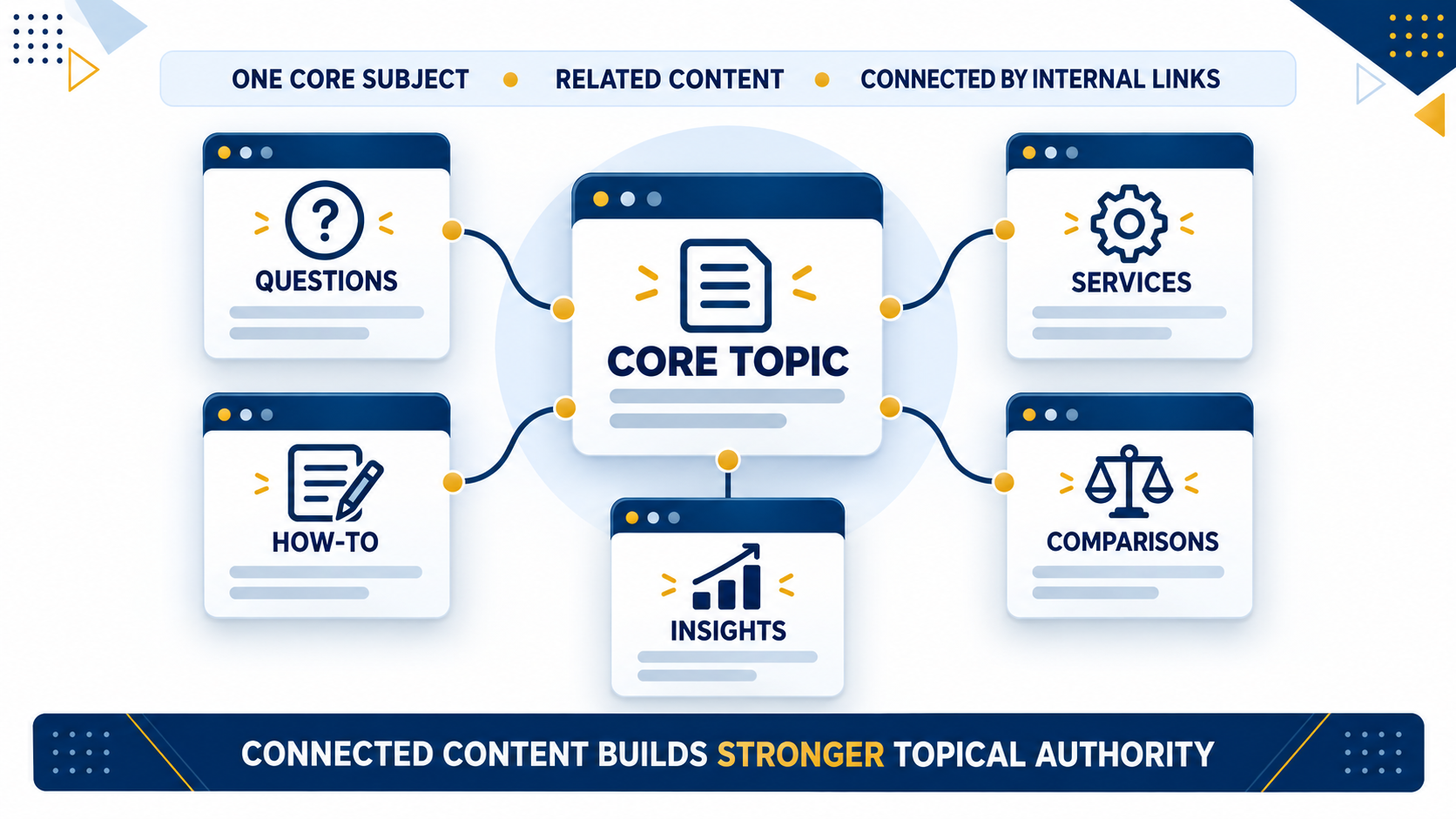
A structured topic cluster SEO strategy groups a main topic with supporting articles that explore related questions, services, and subtopics. This helps create a clearer content structure for both search engines and website visitors.
A Topic Cluster Starts With One Core Subject
The first step is identifying a subject that is important to the business.
This core topic should be broad enough to support multiple related articles while still being relevant to the company’s products, services, or expertise.
A focused SEO topic cluster gives businesses a central theme around which supporting content can be developed.
Supporting Articles Add Depth
The main page does not need to answer every possible question.
Supporting articles can explore specific concerns, comparisons, processes, benefits, trends, or frequently asked questions connected to the core topic.
This allows content cluster strategy to create greater depth without forcing too much information into one page.
Internal Links Connect the Cluster
Links are what turn related articles into an organized cluster.
Supporting pages can link back to the main topic page, while the main page can guide readers toward relevant supporting resources.
A thoughtful internal linking strategy helps search engines understand how the pages are connected while giving visitors an easier way to explore related information.
Topic Clusters Can Strengthen Topical Authority
Search visibility is influenced by how completely a website covers relevant subjects.
When a business consistently publishes useful content around a particular theme, search engines receive more context about the website’s area of expertise.
A well-developed topic cluster SEO strategy can therefore support stronger topical relevance over time.
Keyword Research Can Guide Cluster Development
Topic clusters should not be created based only on assumptions.
Keyword research can reveal related searches, common questions, supporting terms, and content gaps around the main topic. These findings can help determine which supporting articles should be developed first.
This makes SEO content planning an important part of building useful content clusters.
Clusters Can Reduce Random Content Creation
Without a clear structure, websites may publish articles that attract traffic but have little connection to important services or business objectives.
A content cluster strategy provides more direction by linking individual articles to larger search themes.
This helps businesses build a content library that supports specific areas of expertise instead of producing isolated posts with limited long-term value.
Existing Content Can Be Reorganized Into Clusters
Topic clusters do not always require starting from zero.
Existing articles may already cover related subjects and can sometimes be grouped around a stronger central page. Internal links, updated headings, and improved structure can help connect these pieces.
This makes SEO topic clusters useful not only for new content planning but also for improving existing website resources.
Performance Data Can Reveal Which Clusters Are Growing
Once a topic cluster is established, performance should be monitored.
Search impressions, rankings, organic traffic, internal link activity, and conversions can help show which topics are gaining visibility and which supporting pages may need improvement.
Reviewing these signals allows the topic cluster SEO strategy to develop based on actual results.
ANT Builds Content Around Search Themes That Matter
At Archipelago Network Technology Inc. (ANT), SEO content can be organized around keyword research, website structure, service priorities, and search behavior.
Archipelago Network Technology Inc. (ANT) can support businesses through keyword research, topic planning, pillar-page development, supporting article creation, internal linking, and performance monitoring.
This gives content a clearer role within the broader digital marketing strategy.
Connected Content Can Create Stronger Search Visibility
One article may answer one search, but a connected group of useful pages can support a much broader subject.
A structured topic cluster SEO strategy helps businesses organize content around themes that matter to both audiences and search engines.
When core pages, supporting articles, keywords, and internal links work together, website content can become easier to navigate, more purposeful, and better positioned for long-term organic growth.